

TRM Research · Report
The Ask Gap: the review practice nobody measures
What service businesses are told about reviews, what their customers expect, and the practice in between.
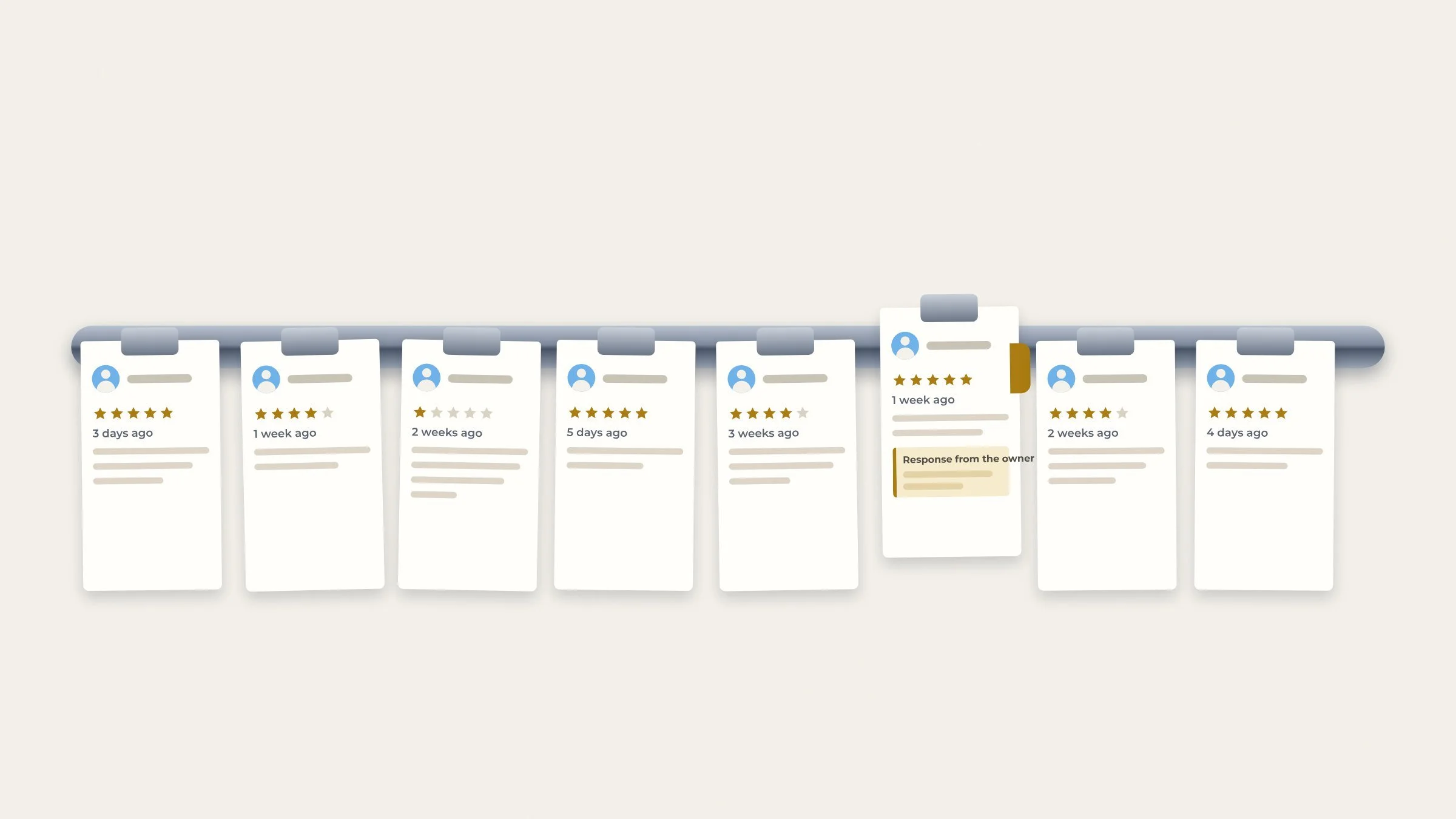
Owners are told how to ask for reviews. Customers are watching how owners answer them. Almost no one measures the practice in between: whether every served customer is invited at the right moment, and whether every review gets a reply. In 2026, 89% of US consumers say they expect owners to respond to reviews, yet only about half of owners do (BrightLocal, 2026). TRM’s own read of 46,771 Google reviews across 986 US service businesses found 58.9% got an owner reply, but only 12.0% got one within a week.
In short, for an owner: invite every customer the same way, right after the moment that earned it; reply to every review, soon, in your own words; and measure those habits, not the count.
1. What owners are told
The advice owners find is about mechanics, and it ends at the count. Popular 2026 how-to guides from software and marketing sites converge on the same few steps (read November 23, 2026):
AI answer engines give the same answer. Asked by an HVAC owner whose customers like the work but whose rating is low, one engine with live web search listed six steps and ended with tracking requests sent, new reviews and the rating each week (Perplexity, sampled November 23, 2026). No step named the moment an invitation is earned, or how an owner would know the team runs the practice.
Search behavior matches. In the US, “how to get more google reviews” draws about 590 searches a month, and “how to ask customers for reviews” about 480; owners rarely search the deeper problem, such as getting staff to ask (Google Ads estimates, read November 23, 2026).
policy-violating reviews Google says it blocked or removed in 2025, up from 240 million in 2024 (Google, April 2026; Search Engine Roundtable). The stakes for getting the practice wrong are rising.
2. What owners tried
The market already names the real problem: the team won’t ask. Its fixes then pay or pressure them to.
Paying the team
A review-software company’s survey of its own customers found 56% incentivize employees to collect reviews. A field-service software blog recommends paying staff for the reviews they bring in.
Handing the ask to software
Owner-written reviews of review tools on public software-review sites describe paying for automated requests and seeing little change: in one, almost nothing new in five months under contract, plus repeat requests to customers who had already reviewed (read November 23, 2026; no business or tool named here).
Each fix measured something real: requests sent, reviews per person, the rating. None of them measured the moment the invitation landed in, or whether every customer was invited the same way.
3. What customers expect
Customers read reviews closely, read them recently, and watch whether the owner answers. From BrightLocal’s Local Consumer Review Survey 2026 (1,002 US adults, published February 11, 2026; BrightLocal sells local marketing and review software, so its findings are cited with that disclosed):
- Read reviews for local businesses97%
- Expect owners to respond to reviews89%
- Only care about reviews from the last three months74%
- Put off by templated or generic replies50%
- Unlikely to use a business that ignores its reviews42%
- Always read reviews when browsing41%
- Want a reply by the next day (18% in 2025)32%
BrightLocal’s October 2026 small-business report puts the owners who respond to reviews at 51% (report). The survey also finds AI tools such as ChatGPT rose from 6% to 45% as a source of local business recommendations, so the reviews an owner leaves unanswered are now read by people an AI sent.
4. What TRM measured: how service businesses actually reply
Surveys report what people say. To see what businesses do, The Reciprocity Method™ read the public Google reviews of 986 US service businesses, 46,771 reviews in all, and checked each one for an owner reply and how long it took (TRM Review Reply-Rate Study, data read October 30, 2026). Most businesses do reply; far fewer reply soon, and the slowest replies go to the reviews that need them most.
Who waited longest
| Measure | Result |
|---|---|
| Reviews that received an owner reply at all | 58.9% |
| Reviews that received a reply within 7 days | 12.0% |
| Median time to reply | 27 days |
| Replies that came more than 30 days after the review | 46.6% |
| Businesses that replied to at least 90% of recent reviews | 39.7% |
| Businesses that replied to none | 11.7% |
| One- and two-star reviews replied to (vs 60.5% of four- and five-star) | 48.4% |
The gap to customers is speed. A third of consumers now want a reply by the next day, and about one review in eight gets one within a week. (The two figures come from different samples, so read them as a direction, not a match.) The practice is within reach: nearly four in ten businesses already reply to almost every recent review.
How it was measured. Five trades (car repair, HVAC, general contractors, car dealers, property management) in ten large US metros; claimed Google listings with at least 30 reviews; each business’s newest 50 reviews; source DataForSEO’s Google reviews data. A reply is an owner response on the review; time to reply is the owner’s reply time minus the review time, and replies dated before the review (likely edits) are left out of the timing figures, so those figures are conservative. It is a sample of established listings in large metros, not a census, and it measures a recent window of practice rather than a lifetime record. No business is named, ranked or identified. The full findings, by trade and by star rating, are in the Review Guide.
TRM’s figure (58.9% of reviews answered) and BrightLocal’s (51% of owners who say they respond) measure different things, reviews observed versus owners surveyed, and both point the same way: a large share of the conversation customers are watching goes unanswered or answered late.
5. The gap: what is counted, and what nobody measures
Everything above counts outcomes: requests sent, reviews received, the rating. Customers judge something else: whether they were treated well, invited fairly, and answered. That is a practice, and it can be measured at team level.
Your own records
Ask Coverage
Every served customer gets the same invitation.
Invitations made ÷ customers served
Your own records
Moment Fidelity
The invitation comes right after the moment that earned it.
Invitations at an earned moment ÷ all invitations
Public data
Reply Rate
Every review gets a reply.
Reviews answered ÷ reviews received
Your own records
Resolution Rate
Every problem that comes back gets a documented answer.
Negative reviews with a documented service response ÷ negative reviews
Only Reply Rate can be read from public data. The other three live in a business’s own records, which is why no dashboard built on public review counts can show them.
These are team numbers. Ranking, rewarding or pressuring one person by their review count turns them back into the quota the policies above prohibit. Measure the practice, not the stars.
6. What this means for an owner
If the tools, the bonus or the meeting did not hold, the effort was not wasted and the team is not the problem. The advice measured the wrong thing. Nobody showed you where to look.
Three questions close most of the gap:
Does every customer we serve get the same invitation, from the person who helped them?
Does the invitation come right after the moment that earned it, not on a timer days later?
Does every review, good or bad, get a reply in our own words, soon?
It’s not something you do extra… it’s something you do different.
The Reciprocity Method™ is built on that practice, measured at team level. It can and should produce results, but it does not guarantee them; the result belongs to the business that practices it.
7. Method, limits and sources
This report uses public, third-party data and TRM’s own study, each figure with its source and date. It makes no claim about results TRM has produced. Survey figures come from publishers that sell review or marketing software, and are cited with that disclosed. The AI-answer and search-volume reads are single samples from November 23, 2026.
- The Reciprocity Method™, TRM Review Reply-Rate Study: 986 businesses, 46,771 Google reviews, data read October 30, 2026 via DataForSEO (method and limits in section 4)
- BrightLocal, Local Consumer Review Survey 2026, published February 11, 2026 (read November 23, 2026)
- BrightLocal, Small businesses can’t keep up with consumer review expectations, October 21, 2026 (read November 23, 2026)
- Google, Maps prohibited and restricted content policy (read November 23, 2026; the page shows no update date)
- Widewail, Google just doubled down on review integrity, March 18, 2026 (read November 23, 2026)
- Google, New ways we’re protecting businesses on Maps, April 2026 (read November 23, 2026)
- Search Engine Roundtable, Google Maps blocked 292 million reviews, April 17, 2026 (read November 23, 2026)
- A review-software company’s page reporting a survey of its own customers on staff incentives (page, undated; read November 23, 2026)
- A field-service software company’s blog on team incentives (page, read November 23, 2026)
How to cite this report
The Reciprocity Method™. “TRM Research — The Ask Gap: What Service Businesses Are Told About Reviews, What Their Customers Expect, and the Practice Nobody Measures.” 2026. https://www.reciprocitymethod.com/the-ask-gap
Research FAQ
Questions?
What is the Ask Gap?
The space between what owners are told about reviews and what customers watch for. The advice owners receive ends at the count: send more requests, automate them, track how many arrive. Customers judge the practice: whether they were invited fairly and whether the owner answered, soon. Almost no one measures that practice.
Do customers expect businesses to reply to reviews?
Yes. In BrightLocal’s 2026 survey of 1,002 US adults, 89% said they expect owners to respond to reviews, and 32% want a reply by the next day, up from 18% in 2025.
How long do businesses take to reply to Google reviews?
In TRM’s study of 986 US service businesses, the median wait for a reply that came was 27 days, and only 12.0% of reviews got a reply within seven days.
Can I ask only happy customers, or give staff a review quota?
Google’s Maps content policy bars both: merchants may not selectively solicit positive reviews or ask staff to solicit a certain number of reviews, and incentives of any kind in exchange for a review are barred. Invite every customer the same way instead.
What should an owner measure instead of review counts?
Four team-level practice measures: Ask Coverage, Moment Fidelity, Reply Rate and Resolution Rate. Only Reply Rate can be read from public data; the other three live in a business’s own records.
Can I use these figures?
Yes. Quote any figure with its source as listed in section 7, and link to this page so readers can see the method and its limits.
The exchange
We gave you the report. Your turn.
That was TRM Research — The Ask Gap, in full — our gift to you, no strings, no commitment. To see where your own team’s practice stands, take the free Reputation Diagnostic: ten questions, and the result names the habit holding you back. Giving is the first turn of the loop — the first small exchange, the reciprocity, that builds relationship equity.
Free. Ten questions. Your result names your weakest habit and your next step.
Where to go next.

TRM Research
How soon do businesses answer?
46,771 Google reviews of 986 local businesses: how often owners reply, and how soon.
Read the research
The Guides
Check your own review replies
A free prompt checks your last 20 Google reviews: how many you answered, and who is still waiting.
Read the Guide
The Guides
Answer every review, good and bad.
Who your reply is really for, the steps for a hard review, and three sample replies to adapt.
Read the Guide Free
The Diagnostic
Know where you stand.
Ten questions: your practice stage, your weakest habit and your next step.
Take the Diagnostic
How it works
Four moves, every customer, every day.
Trust, listen, identify, solve.
See How It Works
The Guides
Invite every customer, the same way.
Ask every customer the same way, right after your team’s best care, without pressure.
Read the Guide
The Guides
Settle every complaint.
Treat every complaint as a burden to share: six steps, a sample reply, and how to stay calm with difficult customers.
Read the Guide
The Frontline Phrase System
The right words before the review.
A reply handles the review. These nine cards handle the moments that come before it, from the bad-news conversation to the graceful goodbye, each with what not to say and what to say instead.
See the Frontline cards Free
Step One
Why counting reviews costs you reviews.
When reviews become the target, the ask drifts toward the customers likeliest to praise and away from everyone else. Step One of the Ten Steps shows what to measure instead, free and in full.
Read Step One
Your first step
The care is already there. Let’s make it compound.
Free to join. Members sign in on the same page.
