
The Guides · Choosing a review tool
Before you sign another review contract
Most review tools count reviews and stars. Four questions show whether one supports the practice behind them.
Most review tools are sold on what they can count: requests sent, reviews received, the star average. What they can’t count is what decides whether a customer says anything at all: the moment your team earned it, and whether anyone invited them while it was still fresh. Before you sign, ask what the tool will measure, who does the inviting, what happens to the moment, and how you’d know the practice runs.
1. What will the tool measure?
Look at the dashboard or report the proposal shows. Most measure outcomes: how many requests went out, how many reviews came back, the average rating. Those numbers tell you what happened. They don’t tell you why, or whether it will keep happening.
Look for anything that measures what your team does, not just what customers post. The Reciprocity Method™ measures the practice with four numbers. Ask whether the tool can show each of them:
Your own records
Ask Coverage
Of the customers you served, how many were invited?
Invitations made ÷ customers served
Your own records
Moment Fidelity
Did the invitation come when the service earned it?
Invitations at an earned moment ÷ all invitations
Public data
Reply Rate
Did every review get an answer?
Reviews answered ÷ reviews received
Your own records
Resolution Rate
Did every problem a customer raised get resolved?
Negative reviews with a documented service response ÷ negative reviews
If it only counts reviews and stars, you’ll know the score, but not the practice that produces it.
2. Who does the inviting?
A text or email sent automatically after a job is convenient. It’s also the same kind of message customers already get from every business they use. The Method teaches that the invitation that lands comes from the person who just served the customer, in their own words, while the work is in front of them.
Does the tool support your team’s own invitation, or replace it?
A tool can record and remind. It can’t earn the moment for you.
Does every customer get invited the same way?
Or does someone, or something, decide who gets asked?
If the tool picks who gets a request, how does it choose?
A tool that sends requests only to customers it predicts are happy is filtering. Google’s review policy prohibits selectively asking for positive reviews.
Rules differ by platform: Yelp, for one, asks businesses not to request reviews at all. Check each platform you care about before you sign.
Source: Google, Maps user-generated content policy: prohibited and restricted content, read November 26, 2026.
If the software does all the asking, your team learns nothing about the moment, and the habit stops when the subscription does.
3. What happens to the moment?
Every invitation starts with a moment: the leak fixed before dinner, the question answered without a second call, the follow-up nobody expected. A request that arrives two days later by text competes with everything else on the customer’s phone. By then the moment has cooled.
A tool can send the invitation. Only your team can earn the moment.
When does the request go out?
At the moment of service, or on a fixed delay?
Who marks the moment?
Can your team mark the moment worth inviting, or does a timer decide?
What if there was no moment?
When the job was routine, a good answer is that your team makes one, such as a quick walkthrough of what was done or a check that the customer has what they need, then invites.
4. How would you know the practice runs?
A tool can be switched on and still change nothing your team does. Six months later the review count may be up, flat or down, and you won’t know which habit caused it. Look for a way to see the practice itself, week by week, at team level.
| What most reports show | What to ask for beside it |
|---|---|
| Requests sent | How many of the customers you served were invited |
| Reviews received | How many invitations came right after the moment that earned them |
| Average star rating | How many reviews got a reply, and how fast |
| Reviews by team member | The practice at team level, never counted by person |
Per-person tallies turn an invitation into a quota. Google’s policy also prohibits asking staff to collect a set number of reviews.
If the only proof is the review count, you’ll be paying for a number with no practice behind it.
Before you sign
Ask the four questions in writing
Keep the answers with the contract. A good answer is specific and fits in a sentence or two. A vague answer is an answer too.
Take the 12-question list to the seller
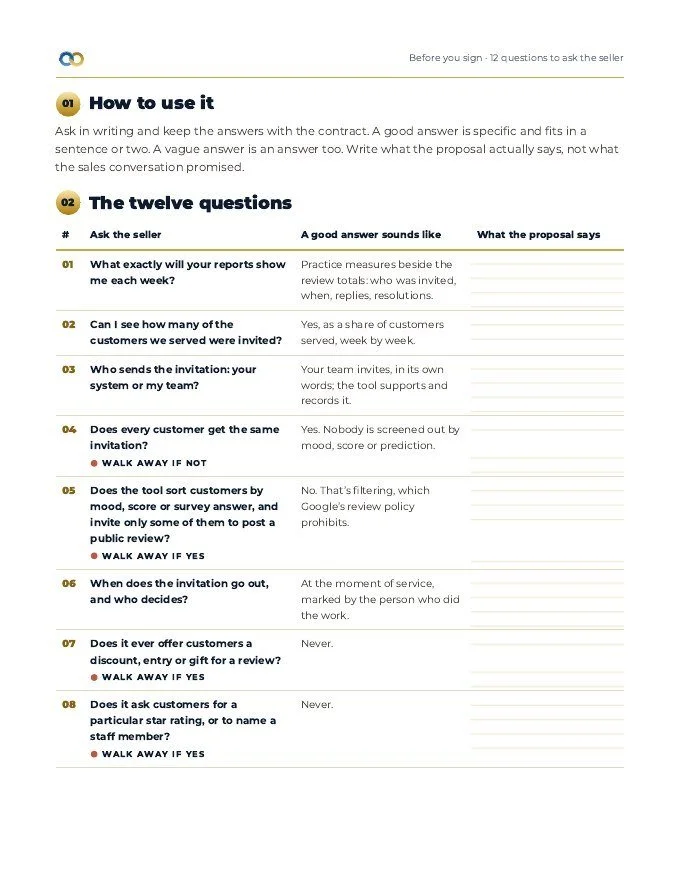
It turns these four into twelve, with what a good answer sounds like and which answers are a reason to walk away. Get it free below.
Check your own practice first
Know which part of your practice leaks, so whatever you choose has something real to work on.
See where your own practice stands. The free Reputation Diagnostic takes a few minutes and shows where your practice is strongest and where it leaks first.
Before you sign
Questions?
Should I use review software at all?
That’s your call. Software can help your team invite and reply. It can’t earn the moment for them. Use the four questions to check that what you buy supports the practice instead of replacing it.
Is it allowed to invite only happy customers?
No. Choosing who gets asked is often called review gating, and Google’s policy bars selectively asking for positive reviews. Invite everyone you served, the same way.
Can a tool offer customers something for a review?
No. Google’s policy bars incentives for reviews. Any tool that offers discounts, entries or gifts for a review is a reason to walk away.
Does every review platform have the same rules?
No. Rules differ by platform. Yelp, for one, asks businesses not to request reviews at all. Check each platform you care about.
Is this legal advice?
No. It’s general guidance on what to ask a seller. For contract terms, talk to your own advisor.
The exchange
We gave you the four questions. Your turn.
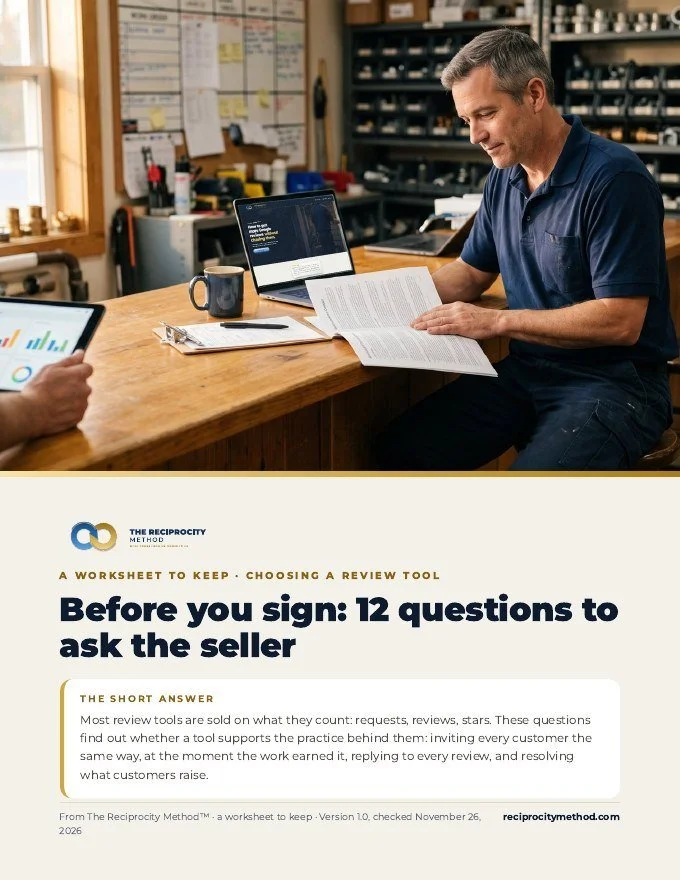
That was Before You Sign, in full — our gift to you, no strings, no commitment. Sign up, and we’ll send you 12 Questions to Ask the Seller — a printable worksheet with what a good answer sounds like, which answers are a reason to walk away, and space for what the proposal says — and, if you tick the box, a free subscription to The Reciprocity Method — Newsletter. Giving is the first turn of the loop — the first small exchange, the reciprocity, that builds relationship equity.
TRM Membership begins upon email confirmation (double opt-in). All communication is handled per our Privacy Policy and Terms.
Where to go next.

The Guides
Get more Google reviews, without chasing them.
The practice that brings reviews in: invite every customer, at the moment, and reply to every review.
Read the Guide
The Guides
Invite every customer, the same way.
Ask every customer the same way, right after your team’s best care, without pressure.
Read the Guide
The Guides
How to get your Google review link
Find, copy and share your Google review link and QR code in a few clicks. Then send the same invitation to every customer you served, with no pressure.
Read the Guide
The Guides
Answer every review, good and bad.
Who your reply is really for, the steps for a hard review, and three sample replies to adapt.
Read the Guide
TRM Research
The review practice nobody measures.
What owners are told about reviews, what customers expect, and the gap between them.
Read the Research Free
The Diagnostic
Know where you stand.
Ten questions: your practice stage, your weakest habit and your next step.
Take the Diagnostic
The Guides
Check your own review replies
A free prompt checks your last 20 Google reviews: how many you answered, and who is still waiting.
Read the Guide Free
Step One
Why counting reviews costs you reviews.
When reviews become the target, the ask drifts toward the customers likeliest to praise and away from everyone else. Step One of the Ten Steps shows what to measure instead, free and in full.
Read Step One
How it works
Four moves, every customer, every day.
Trust, listen, identify, solve.
See How It Works
Your first step
The care is already there. Let’s make it compound.
Free to join. Members sign in on the same page.